
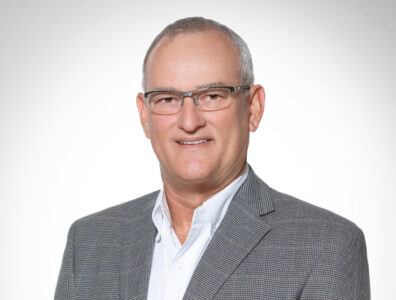
Wayne BERNARD
CEO
ROSCO PROCOM
Strength in diversity
January 18, 2024 Trinidad and Tobago


Wayne Bernard, CEO of Rosco Procom, talks to The Energy Year about how the company’s post-merger product offer broadens its customer base and where it sees the greatest upcoming opportunities. Rosco Procom is a Trinidad-based supplier of industrial, oilfield and energy-related products and services.
It‘s been two years since the merger between Rosco Petroavance and Process Components (Procom). How has this impacted the growth and market share of the business?
The merger has significantly benefited us, even more than we had expected. Before the acquisition, we had a plan and goals we wanted to achieve within a certain timeframe, and we surpassed the goals that we had set for our two-year mark. Our workforce was one of the key factors in that success. We put a lot of effort into getting our teams in alignment – to have them working together and focused on what we wanted to achieve.
The diversity of our business allows us to engage with different sectors even if only indirectly related to the oil and gas sector. We are now truly a one-stop shop and able to support our customers in all the sectors we cover.
As an example of this, if an oil and gas company or operator undergoes a shutdown, they might require a generator, which they can source directly from us. A generator, however, is not a piece of equipment specific to the oil and gas sector; it can also be used in homes, and we do install many generators for homeowners. Our product offer gives us a diversity that broadens our customer base significantly – from the oil and gas market all the way to the residential market.
We understand that you also changed the structure of the business. How has restructuring into four different divisions optimised your operations, and which division accounts for the majority of your work?
Even though we are one company, we recognised early in the merger that we needed to create distinct divisions focused on different sectors and move key competencies into each of them. Each division has a head that is solely responsible for making sure that their division performs optimally. They control how all the employees that work under them focus, they are responsible for the brands, the key competency and the training and are in alignment with all that the division requires.
Among our four divisions, our Oil and Gas division is the largest and accounts for about 35% of our business. This division is where we offer engineered products and services covering from the bottom of an oil well to the surface and the downstream industries. We provide tubulars, centralisers, wellheads, valves, testing and certifications just to name a few products and services. The other 65% is shared among the other three.
The second largest is the Consumer and Commercial division, which is more of a distribution service where we provide Mobil lubricants, Hempel industrial paints and 3M safety products. Then we have our Mechanical and Electrical division where we sell generators, pumps and compressors – rotating-type equipment – and also service all of these.
Rigging and Lifting is our smallest division. We have a factory where we manufacture metal and composite lifting slings and equipment for this sector.
Do you expect that ongoing oil and gas production efforts in Trinidad will present more business opportunities for Rosco Procom?
Yes, the natural gas industry worldwide and in Trinidad will remain a main focus for energy well into the future. As a result, we are also focused on developing more business opportunities with gas-producing companies.
The Ministry of Energy is constantly working to ramp up the country’s natural gas production and we see the steps being taken by some operators to increase production in the short term. We are open to working with those operators as far as our array of services aligns with their operations.
From which sector of activity do you expect to see the most demand for your products and services?
For us, oil and gas is still our leading market. We are seeing more maintenance activity on infrastructure such as downstream plants and offshore facilities. Remember, as a country, we have ageing plants and equipment, so a lot of service work is focused on maintenance currently. Atlantic, for example, has an aggressive maintenance strategy planned for 2024. That activity will follow with operators and services companies engaged with them.
Have you observed any progress in investment in renewable energy technologies by businesses in Trinidad and Tobago?
In Trinidad, the conversation has remained the same for some time. In my opinion, we are behind on our country goals because at a governmental level, laws need to be put in place that allow renewable energy sources to be sold back into the electrical grid.
The only thing preventing Trinidad and Tobago from keeping up with other territories that are using renewable energy is that the legislative framework has not been updated. The cost of the investment in renewables is high, so until the legislation adjusts to allow renewable sources to sell back to the grid, then most businesses will not be willing to make the investment.
In what ways have technology and digitalisation played a role in evolving your business?
Technologies are changing every day. What we are focusing on is how these upgraded technologies already used within our business and the sectors are improving, especially with AI. We are anxious to see how AI can work for us. Therefore, we are innovating here, by implementing digital transformation in our operations to help us do what we do better. Digitalisation will help us remain well structured, well managed and efficient. This helps us stay competitive in our market and make sure that our business structure allows us to expand in any direction that the customer moves.
We are currently working within a CRM [customer relationship management] environment. This helps us map how we communicate and represent ourselves to our customer, this is key. These are also technologies that allow us to map and track how we interact with our customers, and to modify and adapt in ways that will help us to provide the highest quality of customer relations.
We have also invested in digitising our back-office operations with ERP [enterprise resource planning] programmes that help us to develop more efficiency in what we do by gathering data that can then be analysed to better understand pricing structures, delivery times and job efficiency and help us to identify where there are issues that need to be addressed.
Read our latest insights on:
More content from Trinidad and Tobago





Latest Reports


The Energy Year Oman 2026
The Energy Year Kuwait 2025
The Energy Year Angola 2025
The Energy Year Nigeria 2025
The Energy Year Saudi Arabia 2025
The Energy Year UAE 2025